New traders come to trading excited about learning, and looking for a fast path to riches. The majority of new traders can make big mistakes that take their accounts to zero during their learning curve. Traders can grow their capital if they do it correctly, but there are dangers that new traders should be aware of. I hope this blog post saves you a lot of money if you are a new trader, or refreshes your memory if you find yourself tempted to play big and loose with your trading capital. Here are some of the dangers:
Trading too large a position size due to overconfidence of an entry signal. You must limit your trade size to safe levels, and not let faith become your position size metric.
Taking positions in markets that are not liquid enough to handle your trade size. You can lose a lot of money fast by getting in and out of a trade with a wide bid/ask spread. The options market in low volume stocks and penny stocks are the worst for this.
Holding on to a losing trade and not taking your initial stop loss.Getting caught on the wrong side of a trend can turn a small loss into a big loss. Big losses are the number one cause of unprofitable trading.
Adding to a losing trade. This can turn a small loss into a big loss that the ego becomes invested in holding.
Thinking that you will get rich quick. The stronger the urge to get rich quick, the greater the odds that a new trader will take the risks that will lead them to ruin. Slow and steady wins the trading race.
Being under capitalized. Trading an account that has not accumulated enough capital can cause a new trader to take too big of a position size, and take too many risks. Profitability will be nearly impossible, as commissions will be too high of a percentage of each trade. Serious active trading requires at least a five figure trading account. The markets will be here when you are ready.
Trading markets you do not understand. Trading Forex, futures, or options without a full understanding of how they work, and the risks involved, is a formula for disaster. You must gain competence in these markets before you will be successful.
Avoid these dangers and stick with what you know. Trading is a marathon and not a sprint. Make sure you are running in the right direction before you start the race.
There are two very different types of traders, one that wins and one that whines. Whiners hardly ever win and winners rarely whine. Trading is a tough business and you have to be able to keep the right mind set to get you through the rough spots. When the markets start trying to knock you off your trading plan and system. Mental strength more than any other one thing will determine your success. You can come back from losing your whole account but you can’t come back from completely losing your faith and confidence in yourself. Your mind must be one of a winning trader . We should not entertain internal or external whining. Keep the faith, stay focused on your long term destination and what it will take to get there.
Winning traders take responsibility. Whining traders play the victim.
Winning traders take the right entries. Whining traders get in too early or too late and miss the opportunity.
Winning traders find a way to make money. Whining traders find an excuse why they did not.
Winning traders add value by entering a trading discussion. Whining traders add value by leaving a trading discussion.
Winning traders study ten times as much as they trade. Whining traders trade ten times more than they study.
Winning traders enjoy the game and the profits. Whining traders enjoy their delusions of the big score.
Winning traders build a mentor relationship. Whining traders think they are too smart for a mentor.
Winning traders are realistic about their possible returns. Whining traders are delusional about what returns are probable for them.
Winning traders are focused on their trading expertise. Whining traders are scatter brained and their style drifts to what they think will work.
Winning traders approach their trading as a business. Whining traders approach their trading as a hobby or gambling.
Winning is a state of mind as much as a winning process. Whining is trading with the wrong set of mind and feeling like a victim when the error was trading without a good long term process.
Gaps in prices can be one of the strongest indicators of momentum and while many are using gaps as an opportunity to get out of a winning trades many times it is a great entry signal and beginning of a strong trend in the direction of the gap. Gaps work best in growth stocks especially after earnings are reported when they go into an accumulation phase but also at times in indexes as well as equities as an asset class go under accumulation. A gap signals momentum and that nobody is even willing to make a trade in the hole that is created in the chart.
Gaps can be bought at the open for a possible quick gain and good entry but there is still a possibility that the gap could collapse and those are violent but the odds are that the right leading stock will continue in the direction of the gap. Better odds are to wait for the gap to hold for the first hour of trading then make an entry, you may get a better entry on a pull back and avoid being caught if the gap fails and price collapses. I like to buy gaps at the end of the day for the highest probability that it is a gap and go and not a gap and crap.
Gaps in high volatility do not tend to hold and trend as well as a gap out of a clean price base.
A gap off a key moving average or that opens over a key moving average has a better chance of success than a random gap.
A gap into all time highs is especially powerful with all holders now in a profit and tend to just let the profits run.
Shorts caught in gaps can add fuel to the fire of the trend as they are forced to buy to cover.
A great place to set a stop is just under the low of the gap up day, price should not breach that level if it is going to trend. Using and end of day stop gives you better odds of not being shaken out if it just dips there temporarily.
After the low of the day holds and a trend begins over multiple days then the trailing stop could be moved to the 10 day sma and then the 5 day ema to lock in profits but allow the trend to continue in your favor. On a very volatile stock some your the 21 day ema or 20 day sma as a trailing stock to not be shaken out of a winner for me personally that is too far away.
Also be aware that a momentum growth stock that gaps up does not have long term resistance just pauses and higher highs, also overbought indicators are worthless in momentum growth stocks under heavy accumulation by money managers. RSI extremes can go farther than believed.
When caught on the wrong side of a gap against you it is best to just get out in the first 30 minutes, if the gap holds and makes higher highs after the first thirty minutes of the trading day it almost always just gets worse as the day goes on.
Gaps have a way of leaving so many retail traders on the sidelines because they think that was the move and they don’t want to chase. Some of my biggest winners were me buying into gap ups with the right position sizing and letting my winner run.
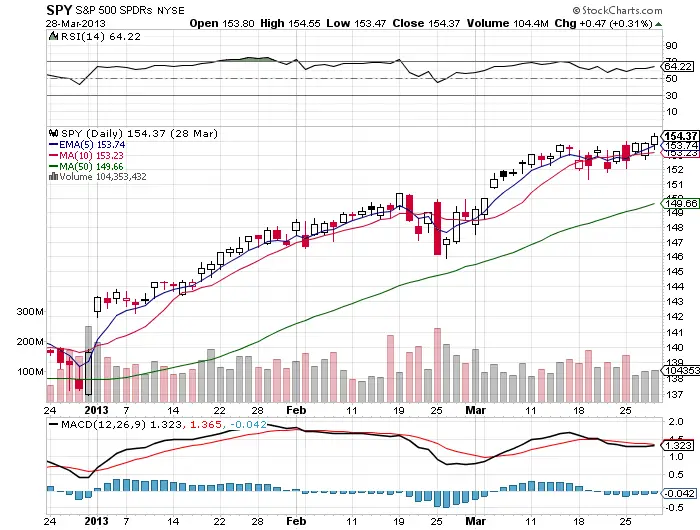
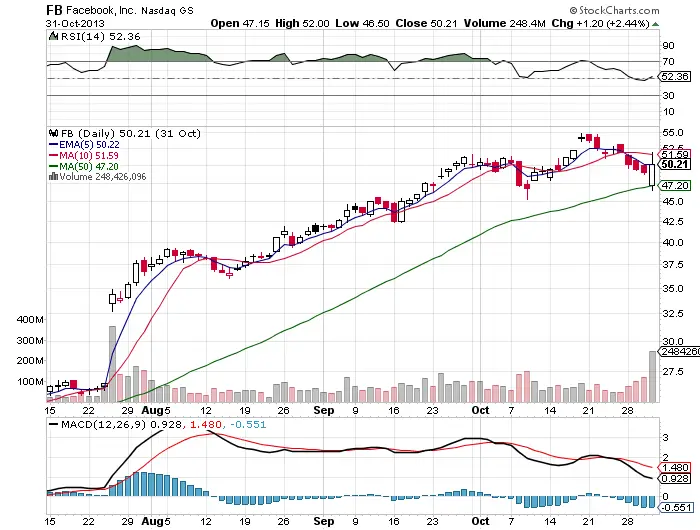
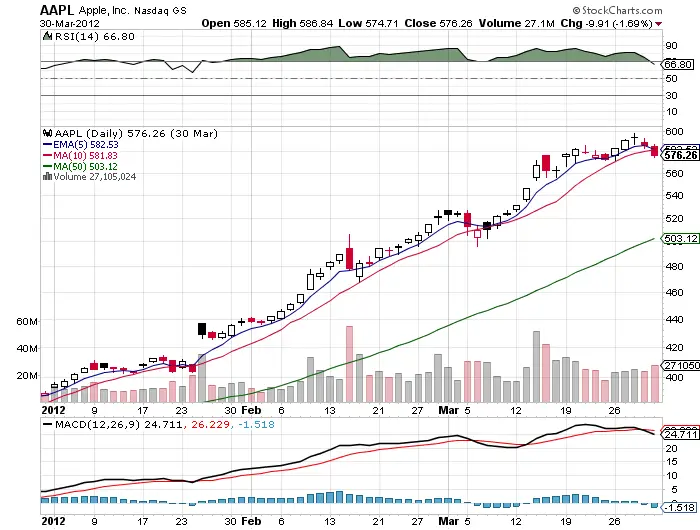
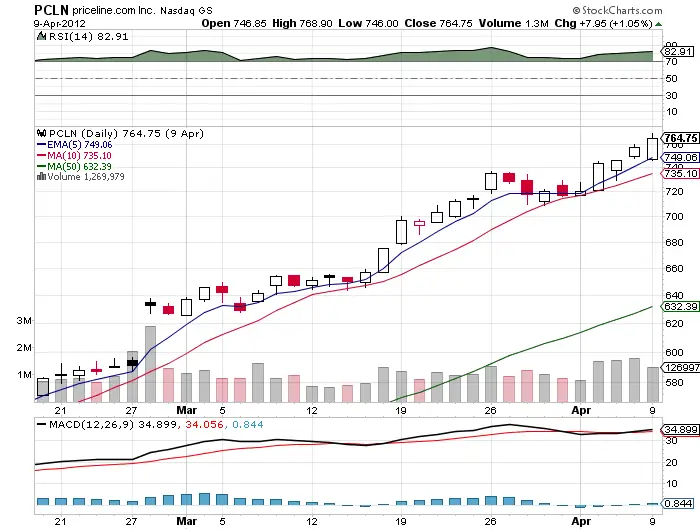
Here are four daily gap up charts I did trade successfully for profits some for big profits some for huge profits. I think it is a great exercise to look at the gap up day and see how it played out and how you would have played it for profits yourself.
Traders may be waiting for the market to settle down and give them more clarity about the trend. For the moving average to hold, for volatility to decrease, for the economic numbers to be more positive, for oil prices to find a range, for your bad luck with entries to end….
The reality is, the market action will NEVER give you the perfect time. That right moment for entry never arrives. The entry will always be difficult; right at the peak of fear the bottom is reached. When the market feels like it will never stop going up a short term top is reached.
Good traders buy the fear at the right time, they sell the greed, they go against the majority when the trend bends and they enter trades that make them uncomfortable. The profitable traders trade a system that has a mathematical and emotional edge over their opponents. Trading is never easy because the profits usually arise from signals that are counter-intuitive. Buying momentum and greed can work in an uptrend and selling short can work in a downtrend. These signals work best in the beginning of that trend, when the trade seems particularly difficult.
Profitable traders take trades when their signals are triggered, even if they don’t believe in them at that moment. They understand the historical price performance and what is possible.
Their trading plan is their boss. Their signals are their gurus. Their trading system is what gives them the faith to click their mouse and put real money at risk in the belief that they can win. They have faith in themselves and their methodology. That is how they can click the mouse and make the trade. Can you?
Day traders can lose money in markets with low volatility.
Trend followers don’t make money without a trend and lose money in whipsawing markets.
Swing traders can’t make money in tight ranges.
Investors lose money in bear markets.
Option buyers need trends to make money, and option sellers need small moves in prices to make money.
If you are trading with a robust system, proven principles, and the right position size then trading can be an enjoyable and profitable experience. If you risk too much and trade too randomly, then trading can be a stressful nightmare. If your trading capital is large enough to meet your financial goals, then you can enjoy it as a sport. If you are trading with a small account and trying to pay the light bill each month, you will experience too much stress to trade with a long-term perspective.
Each trade should be just one of the next one hundred. Each trade you make today should just be one for the week. Each week should only be one week during the month. One month’s results are just one out of the entire year. Short-term results can be random; it takes time for a system to play out and to identify an edge during the right market environments that can lead to profitability.
You have to monitor your trading to ensure that you’re following your system’s entries and exits with discipline, and that you are meeting your win percentage and limiting your losses per your trading plan. Trading is about the long game and the fortitude to last long enough to reap the rewards of your efforts. Time is your test, stay with it until you win. Survival is half the battle. The other half is comprised of discipline, risk management, and a robust methodology.
Time is one of the biggest obstacles that traders will face. Success has more to do with how you manage losing streaks and drawdowns because the winning streaks are easy, but patience is the true test of a professional trader.